Friday, January 26, 2007

iPhone - "Works Like Magic"


There's something magical about technology, especially at those breakthrough moments. I'm not sure the iPhone is as much of an iPod-caliber breakthrough as Steve Jobs portrayed it at MacWorld last week, but he does have a David Copperfield air about him when he describes it.

Since technology often carries a certain magic, it gets used by magicians. The best of them bring some amazing technology to the performance, and then make it invisible. Which illustrates what the iPhone and other good technology does well - it makes the man behind the curtain invisible. When technology is really good, it disappears.

And if you haven't seen an excellent adventure/mystery/suspense film since "The Spanish Prisoner," check out "The Illusionist" which just came out on DVD. It's about magic and technology -- and disappearing.

Tuesday, January 23, 2007

What's After What's Next?


Now that collaboration tools like wikis and widgets of Web 2.0 are established enough for business software companies like SAP and IBM to steer applications in their direction, it's time to think about what might be next.

Predicting the future can be a tough gig. (Even when you know the teams.)
Looking past the shift to collaborative content, what's in the next version of the internet? Or what about Web 4.0? Perhaps it's something as Seth Godin suggests that taps you on the shoulder.

Boost's "loopt" is already heading this direction with cell phones. When you're within range of someone in your network, your phone tells you. It can also recommend (or not) a place for dinner based on your network's comments. Prescient or Citroen? Only time will tell.

Thursday, January 18, 2007

Joost Out!


Move over TVU -- Joost is out and destined to be more of an ideavirus than say, "The Venice Project," as it was formerly known. The brains behind of Kazaa and Skype (Zennstrom and Friis) have put together video programming formerly known as TV in a P2P format. Take a look at the beta download here.

Wednesday, January 17, 2007

i.c. stars Hits An Even Dozen in 2007


What better way to start off the new year than by finishing a thousand hours of training and getting off to a fresh start in a technology career? Last week the twelfth group of interns in the i.c. stars program were all smiling bigger than Robbie Gould as they spoke passionately about the world of opportunity opened up to them through their four-month experience in learning about business, leadership and technology. What a great program -- and with perfect timing a new $25,000 scholarship fund has just been announced in partnership with Geneca and DePaul University. See this week's Yahoo! story here.

Saturday, October 21, 2006

Powered by YouTube

How did Google arrive at the $1.6B price to 28-year old former University of Illinois student Steve Chen for his open-source video uplink application? Here's a great example of how a powerful story can be made all the more powerful by video. See this video link about Rick and Dick Hoyt, the most amazing father and son team ever.

Tuesday, October 17, 2006

Root-Cause Analysis and Predictive Value


Every day we're looking for the why. We're looking for the causes of what we see, whether it's changes in our mileage, the fossil record, shootings in Amish country, water on the moon, Mark Foley, you name it; it's constant. When it comes down to it, we're looking for the root causes.

When we see a connection though, there seems to be a tendency to try to interpret based on our expectations. "There must be a reasonable explanation..." - heavy on the "reasonable." It's only natural to do this of course. You can't start from scratch on every conclusion you make. But if A and B are leading to D, we often pursue C or some variation or a wait-and-see if it might still be C attitude.

So how do we get out of this rut? Is it just a matter of being open to results against your expectations? The answer is predictive value. Start with the results and go back and ask a different question. The best theory is one that can anticipate the next outcome.

Don't pretend you have to go back to zero to be open to D being the answer. If your survey results or the results of your campaign are pointing in a direction you hadn't considered (or don't like), don't be bull-headed. Change course.

Wednesday, October 11, 2006

Noise Without Signal


Our family was recently watching the new Curious George movie and at one point I asked my ten-year old son if he noticed anything interesting about a truck the man in the yellow hat was driving. “It’s a Volkswagen” he said immediately. (He’s got a marketing gene.)

In the 70’s, typical urban dwellers saw about 500-2000 messages a day. By 2006, they are seeing between 3000 and 5000. And there’s no mute button for most of them; it’s just clutter. Noise. Marketing noise.

Venture capitalist Guy Kawasaki recently changed the title of his blog to Signal without Noise, as in the opposite of spam. We tend to think of spam as worthless – a spam filter blocks junk. But spam usually has some value for someone, just an absolute lack of targeting. The more the good marketers are able to target their audiences, the more obvious spam becomes and easier to delete, block or ignore. With new ways to identify it like digital markers, getting the value of untargeted noise-without-signal to approach zero and disappear is coming closer to reality.

Friday, October 06, 2006

How Ideas Spread


We think of ideas that spread by word of mouth as most often the new and the clever. But that's not what spreads most, according to a new study available as a free download from the Keller Fay Group. Among several interesting findings is that word of mouth has more to do with the interest level than in novelty. Easy to talk about and worth talking about were leading characteristics, while innovative was in the lowest group.

Tuesday, October 03, 2006

The Best Podcast Ever

Leo LaPorte, host of This Week in Tech, is one of the biggest names in podcasting and has taken a new stance on advertising in the medium. See the Wired article here.

The Second Agenda - Presentation Presence

Think about the first thirty seconds of a sales presentation. Is your audience ever with you from the get-go? Some are there from your first word. Most will take some convincing just to get on the same page.

Once you've developed your main points, keep in mind these three hurdles to get past the jaundiced eye:

Cynicism - overcome by confidence in the person
Skepticism - overcome by trust in experience
Fatalism - overcome by belief in the ability to influence the situation

Weave these three into your agenda outline. If you conquer these, you're on the path to a persuasive argument that begs for a call to action.

Wednesday, September 27, 2006

BSM (IT For Business): The Next Big Thing

"Business Service Management" -- viewing IT processes purely as a business facilitator and not an independent function -- is on the cusp of IT-analyst Gartner's latest hype-cycle for operations management tools. It is making the critical transition from the "Peak of Inflated Expectations" to the "Trough of Disillusionment," (which sounds more like something from John Bunyan's Pilgrim's Progress than typical IT-lingo). Computerworld chimes in with their own agreement that Kool-Aid style BSM is "the next big thing."

BSM is being followed over the expectations peak by the CMDB (database to track IT environments) which IT Week said yesterday is "set to double in the next year," and web services management. The CMDB is at the heart of BSM, so its catching up over the curve is essential to BSM's success and it has made quite a jump from last year's report, in which Gartner projected its productivity at ten years out. In Gartner's assessment, BSM now follows the spread of the IT Infrastructure Library, which provides the foundation of best practices necessary for BSM to work effectively.

Women's clothing manufacturer Coldwater Creek says it has saved more than $1.8 million and gained another million in profit using BSM to speed the opening of new locations, as well as another $700 thousand in licenses and software negotiations, which should help to assuage at least some of their disillusionment.

Tuesday, September 26, 2006

WCd (Web Site Coefficient of Drag)

Visitors to your web site want to know you're interested in their user-experience. One way to make your web site leaner and meaner is to make the PDF's more efficient. Most PDF's are made for print quality and can be made smaller and more streamlined when used on a web site, speeding up the process for the reader. Take a look at some great tips on optimizing Acrobat files here.

Monday, September 25, 2006

Coffee and IT in Detroit


IT professionals may have a tough time finding a Starbucks in the motor city, but a net 9% (12% add/3% reduce) of the CIO’s in Detroit with more than 100 employees expect to hire IT staff in Q4 according to the latest Robert Half Technology IT Hiring Index and Skills Report. This is up a net four points from Q3. Add this news to the thousand jobs being brought to the state by Google for a glimmer of hope through the impending clouds drifting from the auto industry.

Tuesday, September 19, 2006

Warner/youtube - New Realities

Speaking of youtube, yesterday's deal between the fourth-largest record company, Warner Music and Chad Hurley's 19-month old youtube should shake things up a bit for both the pros and the amateurs.

Thursday, September 14, 2006

Move Over YouTube - brightcove

Here's a new player in the webvideo space -- including b2b applications - www.brightcove.com .

Finding (and Creating) IT Talent

Interesting results in a Computerworld poll of companies on what they are doing to locate talent in a tight IT market --

Top Five:
- Create a talent pool of active and passive candidates (55%)
- Emphasize strategic longer-term workforce planning (54%)
- Improve preassessment tools of knowledge and skills (53%)
- Improve company brand as a stellar place to work (36%)
- Invest in online assessment tools for skills of internal and external candidates (23%)

More than one response was allowed, so the percentages are not exclusive, but notice the decisive favor of the top three and their benefit to the company vs. the other two with greater benefit to employees.

Wednesday, September 13, 2006

i.c. stars In The News


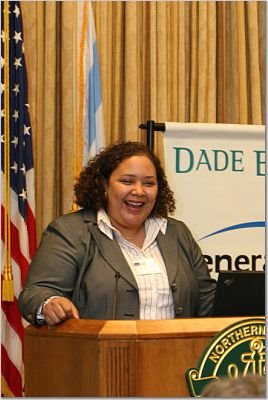
Here's a great video clip highlighting the Chicago-based i.c. stars technology, business and leadership training program. The photo here is founder and president, Sandee Kastrul at the recent Big Bang! event held at Northern Trust.

Watch for their new landing page for prospective interns at www.howcanicstars.org or send the textmark message icstars to 41411.

Tuesday, September 12, 2006

Over The (Phone) Line

Going back to my earlier post about corporate cell phones, it appears Ms. Dunn didn't get away with eavesdropping after all.

Sunday, September 10, 2006

Success Without Compromise

How do you move to the next level? Whether it's George Ryan maintaining his office in the shadow of children burning to death in a van, or a starlet supplementing her celebrity doing "pioneering" magazine covers, or the parade of Hummers and Suburbans lined up outside the daycare center, compromise can offer to move you forward. And refusing it in the type or degree necessary can leave your career languishing in the status quo.

The value of "success" without compromise gives definition to what success is and what a successful person looks like. Encouraging success at any necessary cost leaves it looking hollow in the long run -- "men without chests" in C.S. Lewis' description. Not a politically correct observation; any number of experts and lawyers (or mayors) will be glad to draw up a plan to take things out of the realm of good-or-bad and make them simply "different." Or to offer a sentence that doesn't actually involve real jail time.

But you'll know. Even if you gain the advantage at the moment you'll know. Just a short word of encouragement to stick to your guns and make your successes real ones.

Friday, September 08, 2006

Titles And Actions


For your next corporate event, you're limiting your invitations to Director and above so you know you've got the right people covered, right? Steve Johnson says, "Titles are meaningless; actions are meaningful," especially when it comes to marketing.

In his most recent Pragmatic Marketing newsletter, Steve opens with "Titles really are a mess in our business." He cites Geoffrey Moore's definitions in "Crossing the Chasm" of the difference between a product manager and a product marketing manager, the sum of which is, "A PM listens to the market; a PMM talks to the market."

In the same way there are no IT problems, only business problems addressed by IT, "there are no marketing requirements; only market requirements" addressed by the marketer.